Global web icon
wikipedia.org
https://en.wikipedia.org/wiki/1G
1G - Wikipedia
1G (first generation) refers to the analog mobile telecommunications standards introduced in the late 1970s. The term was later applied retroactively to distinguish these early cellular network systems from later digital generations.
Global web icon
commsbrief.com
https://commsbrief.com/what-do-the-terms-1g-2g-3g-…
What do the terms 1G, 2G, 3G, 4G and 5G really mean? - Commsbrief
1G stands for the first generation of mobile networks that were designed to provide basic voice calling services. 1G networks started in the early 1980s and were introduced in different parts of the world through various FDMA-based analogue technologies, including AMPS, NMT, TACS, J-TACS and C-Netz.
Global web icon
numberanalytics.com
https://www.numberanalytics.com/blog/ultimate-guid…
Understanding 1G Wireless Communications
Explore the history and significance of 1G in wireless communications, its technology, and how it paved the way for future mobile networks.
Global web icon
geeksforgeeks.org
https://www.geeksforgeeks.org/computer-networks/di…
Difference between 1G and 2G - GeeksforGeeks
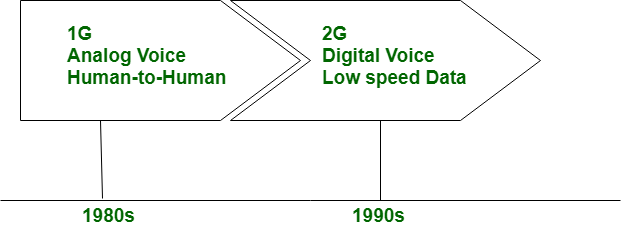
1G stands for first-generation and 2G stands for second-generation are the 2 generations of mobile phones. 1G is the 1st generation of mobile phones that brought 1st wireless communication to the United States. 1G uses associate degree analog signal for communications and uses FDMA for channelization. 1G is employed for spoken language, informat...
Global web icon
techloy.com
https://www.techloy.com/what-is-cellular-network-g…
WHAT IS: Cellular Network Generations (1G, 2G, 3G, 4G, 5G)
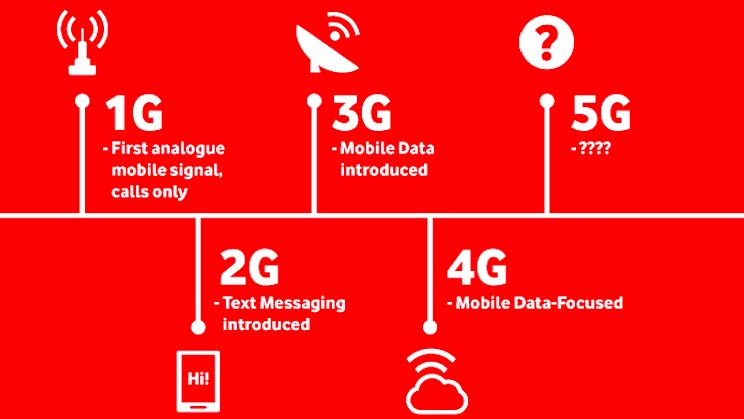
1G, or first-generation wireless, was all about making voice mobile for the first time. Launched in Japan in 1979 and adopted in the U.S. soon after, 1G networks were analog, meaning they transmitted voice data as continuous signals rather than in binary.
Global web icon
thetechnicaltalk.com
https://www.thetechnicaltalk.com/2024/08/understan…
Understanding 1G Cellular Networks: The Foundation of Mobile ...
The first generation of cellular networks, commonly known as 1G, laid the groundwork for the mobile communication systems we rely on today. But what exactly was 1G, and how did it work? In this article, we'll explore the basics of 1G cellular networks, their technology, and their impact on the world.
Global web icon
thetechedvocate.org
https://www.thetechedvocate.org/1g-2g-3g-4g-5g-exp…
1G, 2G, 3G, 4G, & 5G Explained - The Tech Edvocate
The first generation of wireless networks, 1G, was introduced in the 1980s. 1G allowed for analog voice communication over cell networks, but it had many limitations.
Global web icon
insuredandmore.com
https://insuredandmore.com/what-does-the-abbreviat…
What does the abbreviation 1G mean? - InsuredAndMore.com
1G refers to the very first generation of cellular networks. Cellular technology employ a network of cells throughout a geographical area using low-power radio transmitters.
Global web icon
askdifference.com
https://www.askdifference.com/1g-vs-2g/
1G vs. 2G — What’s the Difference?
1G represents the first generation of mobile networks, offering analog voice communication, while 2G introduced digital technology, enabling SMS, MMS, and basic internet services, marking a significant advancement in mobile telecommunications.
Global web icon
techindulge.com
https://www.techindulge.com/technovation/1g-2g-3g-…
1G, 2G, 3G, 4G and 5G Wireless Phone Technology Explained - Techindulge
1G was never widely used as a term to describe wireless phone technology until 2G was available. It is the first generation of wireless telephone technology. These are the analogue telecommunications standards that were introduced in 1979 and the early to mid-1980s.